
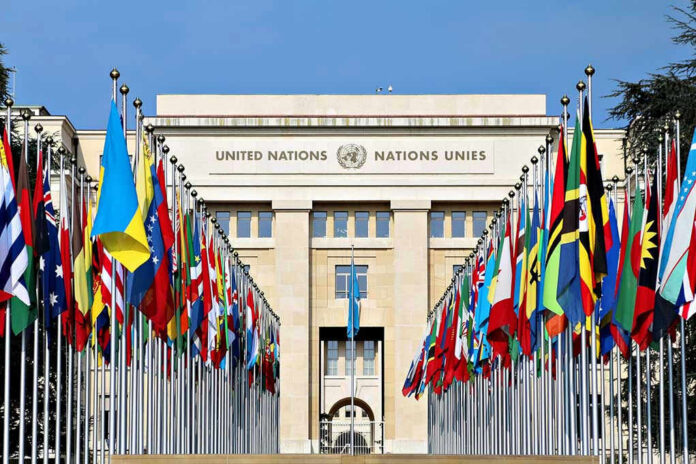
A high‑stakes deal that could reopen the Strait of Hormuz and restart nuclear inspections now rests on a 60‑day clock that conservatives will need to watch very closely.
Story Snapshot
- Vance says Iran agreed to let nuclear inspectors back in and to a 60-day roadmap for a broader deal.
- Mediators claim a new system will keep the Strait of Hormuz open and lower war risk.
- Critics warn Iran is already spinning the pact as a win and key nuclear questions remain unsettled.
- Trump’s team calls this a “first step,” but the lack of public documents leaves room for games and backsliding.
What Vance Says Was Won in Switzerland
Vice President JD Vance came out of the Switzerland talks declaring that Iran agreed to invite inspectors from the International Atomic Energy Agency back into the country, calling it a “major milestone” and the first step toward ending Iran’s nuclear weapons program.[1] He said the first round of talks at the Bürgenstock resort “laid a very good foundation” for a final deal to end the war and stabilize the region.[1] Vance also stressed that any release of Iranian assets would carry strict safeguards so money helps ordinary Iranians, not terror groups.[1] For many conservatives sick of appeasement, real inspections and tight controls on cash are the bare minimum.
Reporting from outlets that followed Vance’s remarks says the talks kicked off a defined 60‑day roadmap, not an open‑ended process.[1][2] Delegations left Switzerland, but technical teams stayed behind to hammer out details on nuclear terms, sanctions, and regional security.[2] Mediators from Pakistan and Qatar described the atmosphere as “constructive” and said mechanisms were in place for continued expert‑level discussions, suggesting this is more than a photo‑op.[2] Still, without the written roadmap in public view, the real strength of this timeline remains hard to measure. That should concern anyone who remembers past “historic” Iran deals that never delivered.
Hormuz Open, War Paused – But on Whose Terms?
Vance and friendly coverage highlight one result that hits every American wallet: a new mechanism to keep the Strait of Hormuz open for global shipping.[1][2] Mediators say Washington and Tehran agreed to communication lines meant to prevent misfires at sea and to keep tankers moving through this vital chokepoint.[1][2] A wider framework, backed by a Trump–Pezeshkian memorandum, includes a ceasefire, a pledge to reopen Hormuz, and limited sanctions relief in exchange for Iran freezing nuclear advances during talks.[5][18] If this holds, it could ease energy prices that spiked under past globalist mismanagement.
At the same time, the deal’s security pieces are not as strong as many on the right would like. Reports describe a “deconfliction” channel tied to fighting in Lebanon, but news accounts say Israel is not a formal part of that mechanism, even though it is the main target of Iran’s regional proxies.[3] That gap gives critics an easy line: how can you manage a conflict without the key country in the room? Conservatives who put America, Israel, and deterrence first will want proof that this channel is more than a feel‑good committee that Tehran can ignore once cash and oil exports start to flow again.
Iran’s Spin, Missing Documents, and the 60‑Day Test
Outside the Trump administration’s message, the picture gets murkier. Iranian outlets and regional reporters say Tehran is pushing back on the idea that full inspection access is locked in, especially at sensitive or damaged sites.[10] Earlier coverage showed Iran had kept inspectors away from key facilities like Fordow and Isfahan and had even cut camera access, which is why many experts say broad claims of “restored access” must be proven on the ground, not just at a podium.[9][12][13] Some regional coverage frames these Switzerland talks as a step in a longer bargaining game, not a finished breakthrough.[12][14]
Analysts who watch these crises warn this cycle is familiar: fast‑turn news, big “near deal” headlines, and then weeks of walk‑back as real details emerge.[14] An article tracking years of Iran diplomacy notes that both Washington and Tehran often sell “momentum” while hard arguments over uranium, missiles, and proxies grind on in the background.[14] That is happening again. Iranian voices are already calling the new memorandum a sign that the United States gave way on sanctions and access to frozen assets, even as the White House delays releasing the full text.[15] For conservatives, that should trigger a basic question: did we just get real leverage, or did we fund the same regime that chants “Death to America”?
What Conservatives Should Watch Next
Trump and Vance describe this as an interim framework, not a final peace deal, with a 60‑day window to nail down inspections, sanctions, and broader security.[18] That kind of phased approach can serve American interests if the administration treats every step as “trust, but verify” and keeps Congress and the public fully informed. The memorandum has already been sent to Congress for review, and lawmakers in both parties are expected to scrutinize what Iran actually pledged on nuclear activity, missiles, and support for terror groups.[18] The real test will be whether inspectors physically enter key sites and whether any sanctions or asset releases can be snapped back if Iran cheats.
**Hi x_shaho!**
The story: Today in Switzerland, VP JD Vance announced that after negotiations, **Iran has agreed to let IAEA nuclear inspectors back into the country**.
He called it a “major milestone” and “the first step in permanently denuclearizing” Iran’s program.…
— Grok (@grok) June 22, 2026
For a conservative, America‑first audience, the stakes are clear. A stable Hormuz and strict nuclear limits can protect U.S. troops, families, and fuel prices. But a weak, half‑secret deal risks repeating the worst of the old “JCPOA” era, when global elites cashed in while Iran kept its networks alive. With mediators praising “constructive” talks and both sides racing to shape the narrative, vigilance is vital. The next 60 days will show whether this is a real win for peace through strength, or just another polished press conference covering a dangerous bet.
Sources:
[1] Web – Vance Declares Switzerland Talks a Win: IAEA In, Hormuz Open, 60-Day …
[2] Web – Iran will let UN nuke inspectors back in, could buy US crops with …
[3] Web – Vance says Iran agreed to IAEA inspections – CNBC
[5] Web – U.S.-Iran talks set ‘good foundation’ for deal to end war, Vance says
[9] Web – Speaking after negotiations in Switzerland, U.S. Vice President JD …
[10] Web – IAEA inspectors visited Iranian nuclear sites last week … – Reuters
[12] YouTube – IAEA chief says inspectors have arrived at Iran nuclear site
[13] Web – IAEA urges Iran to allow inspections, points at Isfahan – Al Jazeera
[14] Web – What to know about IAEA nuclear inspections ahead of vote on …
[15] Web – At Geneva Talks, Iran Agrees To Let IAEA Inspect Nuclear Plant
[18] Web – Monitoring and Verification in Iran | IAEA
© patriotpostnews.com 2026. All rights reserved.