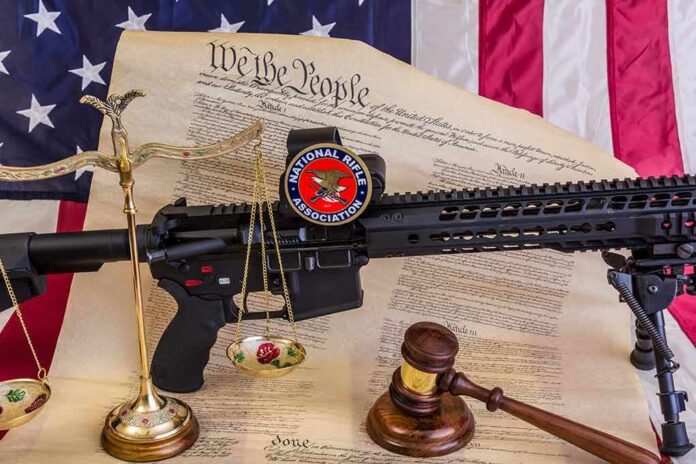
The Supreme Court’s decision to finally judge the constitutionality of AR-15 and “assault weapon” bans puts the power of ordinary citizens versus government control squarely on the line.
Story Snapshot
- The Supreme Court will hear consolidated challenges to bans on popular semiautomatic rifles like the AR-15.
- Gun owners argue these rifles are in common lawful use and are protected “arms” under the Second Amendment.
- States and counties say AR-15s are “dangerous and unusual” military-style weapons that can be banned for public safety.
- The ruling could reshape how far governments can go in limiting gun rights and other personal freedoms.
Supreme Court Takes Up AR-15 Bans After Years of Delay
The United States Supreme Court has agreed to hear several linked cases that challenge bans on semiautomatic rifles, including AR-15 style firearms, from places like Cook County, Illinois, and the state of Connecticut. These cases ask a simple but explosive question: does the Constitution protect owning AR-15s and similar rifles, or can local and state governments outlaw them as “assault weapons” in the name of safety? Gun rights groups have pushed for this review for years, arguing lower courts ducked clear Supreme Court guidance and used legal tricks to keep these bans alive.
In Viramontes v. Cook County, the petition to the Court argues that AR-15 platform rifles are “arms” that millions of Americans own for lawful purposes, so they fall under the Second Amendment’s shield. The brief leans heavily on the Supreme Court’s earlier decisions in District of Columbia v. Heller and New York State Rifle and Pistol Association v. Bruen, which say weapons “in common use” by law-abiding citizens cannot simply be banned. Supporters say modern rifles capable of multiple shots were known at the time of the Founders and that the AR-15 is not a special “military-grade” outlier but a normal self-defense and sporting tool.
Common Use Versus “Dangerous and Unusual” Weapons
Gun owners point to numbers to back their claim that AR-15s are everyday firearms, not rare weapons of war. One widely cited estimate says more than 32 million AR-15s are in circulation, more than the number of Ford F-150 pickup trucks on American roads, showing broad lawful use in homes and sport shooting. They also highlight statements from Justice Brett Kavanaugh, who has written that there is a “strong argument” AR-15s are in common use and that it is hard to tell them apart from handguns already protected under Heller. This side warns that if such widely owned rifles can be banned, then no popular tool of self-defense is truly safe from future restrictions.
Supporters of the bans respond with a very different frame. They argue that AR-15s and similar semiautomatic rifles with detachable magazines and military-style features are “dangerous and unusual” weapons that fall outside Second Amendment protection. Courts in the Fourth Circuit, Second Circuit, and Seventh Circuit have backed that view in cases upholding Maryland, Illinois, and other assault weapon bans. These decisions often lean on Heller’s language saying the right to keep and bear arms is “not unlimited” and that some especially dangerous weapons may be banned, especially when tied to mass shootings. For these judges and lawmakers, the rifle’s design and its use in high-profile tragedies outweigh claims about how many are owned.
How Connecticut and Illinois Built Their “Assault Weapon” Laws
Connecticut tightened its gun laws after the 2012 Sandy Hook Elementary School shooting, where an AR-15 was used to kill children and teachers. The state’s post-Sandy Hook law expanded the list of banned rifles and magazines and was sold to the public as a way to prevent future mass killings. Advocates like Mark Barden, who lost his son in the attack, say the law has “saved lives” and must be defended. To many families and activists, these bans are not abstract; they are emotional promises that government will act to stop the worst forms of gun violence.
Illinois followed a similar path with its statewide Protect Illinois Communities Act in 2023. The law bans the sale of many semiautomatic rifles and large magazines and forces current owners to file endorsement affidavits if they want to keep their guns. Cook County’s earlier ordinance goes further by listing banned guns based on features such as pistol grips and detachable magazines and tying the list to public safety concerns. Critics say this turns millions of otherwise law-abiding citizens into paperwork targets and gives state police and local officials wide power to track and control gun ownership.
Deep Fears About Government Power On Both Sides
Behind the legal briefs, this fight taps into a deeper anger shared by many Americans on the right and left. Gun rights groups such as the Second Amendment Foundation and Firearms Policy Coalition say assault weapon bans are part of a broader pattern where unelected judges and bureaucrats chip away at clear constitutional rights using vague safety claims. They argue that the “text and history” test from Bruen is being twisted, and that some courts have defied the common use standard by upholding bans on weapons millions of people own. For many conservatives and libertarians, AR-15 bans look like proof that the ruling class does not trust ordinary citizens with real power.
The Supreme Court announced Tuesday it will consider in its next session whether states and local governments can ban semiautomatic rifles like the AR-15.
The court cases challenge bans in Illinois and Connecticut. @FredLucasWH https://t.co/kZmBKjNYBK
— The Daily Signal (@DailySignal) July 1, 2026
On the other side, groups like Giffords Law Center and Sandy Hook Promise see the same system as too weak, not too strong. They say the Supreme Court has already recognized that the Second Amendment allows strong gun regulations, and they warn that a sweeping pro-gun ruling could block laws they view as vital to saving lives. Both camps point to big money and media influence flowing to their opponents and worry about “elites” steering policy for their own gain. Many everyday Americans, whether worried about gun violence or government overreach, look at Washington and see leaders more focused on power games than on making neighborhoods safer and freer. This case forces the Supreme Court to confront that distrust and decide how much control the government can claim over tools citizens use to protect themselves.
Sources:
reason.com, illinoiscourts.gov, youtube.com, instagram.com, phase5wsi.com, nycourts.gov, cdn.ca9.uscourts.gov, legalnewsline.com, supremecourt.gov, firearmslaw.duke.edu
© patriotpostnews.com 2026. All rights reserved.