

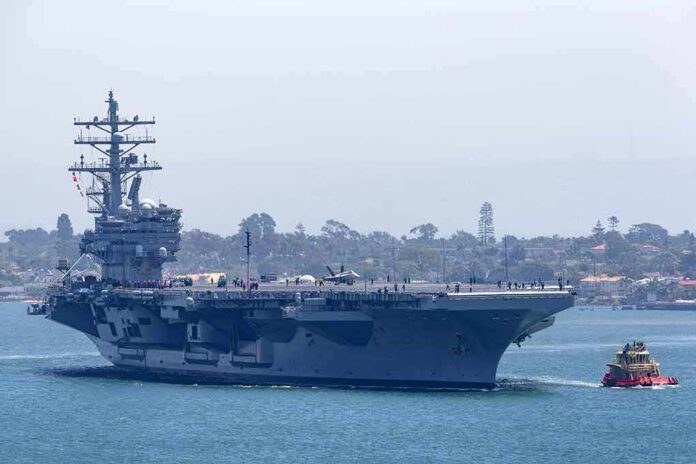
At sea, the Navy is now using 3D printing to make drones and parts on a ship, not back at a factory.
Quick Take
- Firestorm Labs said it made more than 1,000 parts and 12 Squall drones aboard the USS Essex.
- The work happened while the ship was underway on the way to RIMPAC 2026.
- The Navy also tied the test to at-sea resupply and faster logistics.
- Earlier Navy work on the USS Essex shows this is part of a longer push.
Shipboard Printing Becomes a Logistics Test
Firestorm Labs said service members aboard the USS Essex printed more than 1,000 parts and 12 Squall first-person-view drones while the ship moved toward RIMPAC 2026. The company described its xCell system as a containerized microfactory built for Navy use. That makes the experiment more than a tech demo. It is also a test of whether useful hardware can be made while a ship stays at sea and away from shore support.
Defense reporting said the shipboard printing happened without shore resupply, which is the key logistics claim behind the story. Another report said drones and parts were also moved through a broader RIMPAC setup that linked onboard manufacturing with unmanned delivery. That matters because the Navy is not just chasing novelty. It is trying to see whether 3D printing can shorten wait times, reduce spare-parts needs, and keep a ship working during a long deployment.
Why the Navy Cares About This
The Navy has long used additive manufacturing to cut supply delays and make crews more self-sufficient. A Navy release on the USS Bataan said metal 3D printing was meant to improve self-sufficiency and reduce supply chain lead times. The Johns Hopkins Applied Physics Laboratory also says onboard 3D printing can help produce mission-critical parts directly on a ship. The Essex test fits that same goal, but with a harder challenge: building drones in motion, not just spare parts in port.
That is why the details matter. Firestorm Labs said the printed output included repair parts that crew members needed, plus mechanical test pieces used to check the printer itself. A separate report said the platform printed in rough seas with waves up to 12 feet. If those claims hold up, the value is practical, not flashy. A ship that can make its own parts faster may face fewer delays when a weapon, sensor, or drone breaks far from base.
This Is Part of a Longer Navy Pattern
The USS Essex has appeared in Navy printing trials before. Earlier reporting said sailors on the ship used 3D printing to build drone parts and even a small quadcopter as far back as 2014 and 2015. That history shows the current test did not come out of nowhere. The Navy has been building toward this idea for years, moving from simple printed drone pieces to a more advanced setup that can support both drones and shipboard repair needs.
Still, the public record now shows a demo more clearly than a finished doctrine. The reports describe output counts, sea conditions, and a proof-of-concept resupply link, but not a full Navy after-action report. That leaves one central question open: did the system only prove it could print aboard ship, or did it also prove it can sustain combat use over time? For readers on both left and right, that gap is familiar in Washington.
Sources:
redstate.com, 3dprint.com, voxelmatters.com, defence-industry.eu, x.com, sofx.com, marineinsight.com, popularmechanics.com, 163.com
© patriotpostnews.com 2026. All rights reserved.