

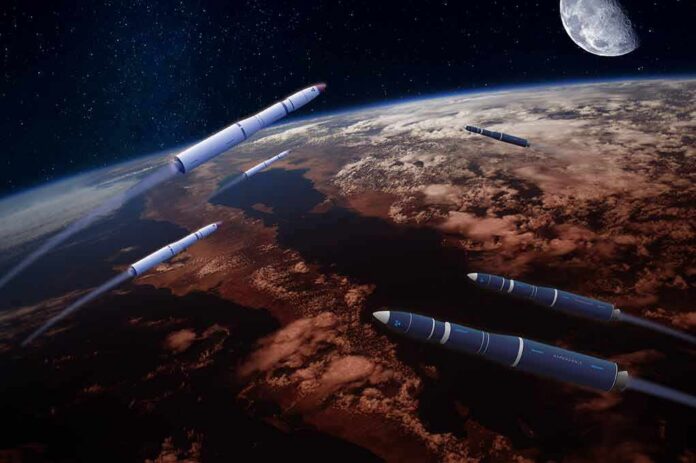
A fiery booster explosion stole the headlines, but SpaceX’s Starship still reached orbit and released 26 satellites.
Story Snapshot
- SpaceX aborted its first planned tower catch of the Super Heavy booster; the booster exploded offshore.
- The upper stage reached orbit and began a roughly day-long mission around Earth.
- Starship deployed 26 next-generation Starlink V3 satellites as a primary payload objective.
- SpaceX framed the flight as a multi-objective test with mixed results, not a single pass-fail event.
What Happened During Flight 15
On Friday in South Texas, SpaceX launched its Starship on Flight 15 to test several goals at once. The plan called for the Super Heavy booster to return to the launch site for a first-of-its-kind catch by the tower arms. SpaceX called off the catch and guided the booster to an offshore descent. The booster then exploded over the Gulf of Mexico. Meanwhile, the upper stage pressed on and reached orbit as planned.
SpaceX commentators said Starship achieved a normal insertion into low Earth orbit. Coverage described a mission of about 22 to 22.5 hours at an altitude near 170 miles, with some 14 laps around Earth before reentry. Those details show the upper stage did not fail after ascent. It remained in space to carry out tests tied to heat shield behavior and systems during a long flight profile.
Payload Deployed Despite Recovery Setback
SpaceX listed deployment of 26 Starlink V3 satellites as a central goal for this test. Reporting states the upper stage released the satellites in sequence after reaching orbit. This delivery adds to the network SpaceX is building for broadband service. The company uses these flights to fold commercial work into testing, which lowers cost and speeds learning for reuse and return operations on future missions.
The mix of outcomes matters. The booster recovery objective was not met, and that was one of the headline goals for the day. But the payload job and orbital mission moved forward. That split result fits how experimental rockets improve. Teams check off what worked and study what did not. Then they update hardware, software, and rules for the next launch cycle.
Why The Catch Was Aborted And What Comes Next
Reports say SpaceX called off the tower catch for reasons not immediately clear. The booster then diverted to a splashdown target about six and a half minutes after liftoff, where it broke apart. SpaceX has performed three Super Heavy catches before with earlier versions, so this was not the first catch ever. But Flight 15 aimed to recover a newer booster version and to attempt the first double catch, which raises the bar.
🚨 BREAKING: 🚀 SpaceX's massive Starship Super Heavy booster explodes over the Gulf of Mexico after its planned landing catch was aborted during Flight 15.
Starship successfully launched and reached orbit, but the booster was diverted to an offshore splashdown instead of… pic.twitter.com/4OQdheq8rz
— Atish Raj Yadav (@Atishrajyadav) November 14, 2026
Expect a standard engineering review to sort the chain of events. That process usually looks at engine health, guidance, and landing-burn data. It also checks whether safety rules told the system to wave off the catch. SpaceX will likely compare the findings to past catch flights to isolate what changed. The company’s public materials frame these tests by objective, which helps explain why this counts as progress despite the highly visible failure.
Why This Matters For America’s Space Ambitions
Reusable rockets promise lower costs, faster cadence, and more access to space. That progress can help national security launches, science missions, and commercial work. But reuse is hard. Launch, staging, recovery, and rapid turnaround each add risk. The United States benefits when private firms push the edge while staying within safety rules. Taxpayers, customers, and citizens want results that are cheaper, safer, and repeatable, not flashy one-offs.
People across the political spectrum share a concern: America needs real problem-solving, not spin. This flight offered both a public failure and concrete gains. The booster’s explosion is a setback. The orbit and the 26-satellite deployment are wins. Holding both ideas at once is key. Measured testing, clear reporting, and quick fixes build trust. If companies and regulators stay focused on facts and performance, the country gets closer to reliable, low-cost space access.
Sources:
spacex.com, bbc.com, space.com
© patriotpostnews.com 2026. All rights reserved.