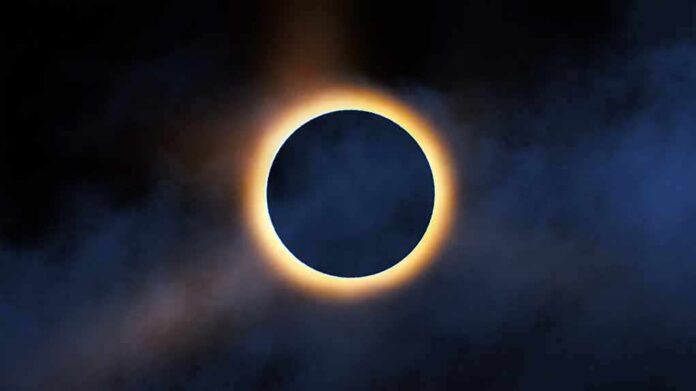
As forecast years in advance, the Moon’s shadow swept across Greenland on August 12, 2026, bringing full daylight to a halt and revealing the Sun’s delicate corona.
Story Highlights
- NASA forecast and live coverage matched on-the-ground views of totality in Greenland.
- The path crossed Greenland, Iceland, and northern Spain, with minutes of eerie midday darkness.
- Timetables showed totality in parts of Greenland around 4:12–4:40 p.m. local time.
- Scientists and travelers reported the diamond ring and bright solar corona during totality.
What Happened Over Greenland
NASA said a total solar eclipse would cross Greenland on August 12, 2026, and it did. The agency laid out the path years earlier and offered live coverage on the day of the event. Time and Date listed Greenland towns seeing totality between about 4:12 p.m. and 4:40 p.m. local time, bracketing a dramatic dusk at midafternoon. Space.com’s live updates traced the shadow as it moved from the Arctic into Greenland and onward to Iceland and Spain.
European Space Agency mapping showed the path of totality over eastern Greenland, which matched reports from travelers and scientists who went there to observe the event. Observers described the classic stages: fast-dropping light, a bright “diamond ring,” and then the ghostly solar corona around the blackened Sun. Those features are hallmarks of totality and help confirm what viewers saw on the ground aligned with predictions made by astronomers.
Why This Eclipse Mattered
This eclipse was the first to bring totality to parts of mainland Europe since 1999, and Greenland offered some of the earliest land views. NASA’s forecast said the shadow would sweep across Greenland, Iceland, and northern Spain, with a narrow band of full coverage and a broader zone of partial coverage around it. That tight band created brief but deep darkness for those who planned, traveled, and braved Arctic terrain to stand inside the path at the right minute.
Precise timing matters because totality is short. Time and Date’s tables showed when the partial phase began, when the total phase started, the end of totality, and when the last bite of the Sun faded. In parts of Greenland, totality lasted close to two minutes. Space.com noted the track’s general flow from the Arctic over Greenland, then to Iceland, and ending near sunset over Spain and the Mediterranean Sea.
How Scientists Predicted It So Precisely
Astronomers use the Moon’s orbit and Earth’s rotation to compute eclipse paths many years in advance. NASA’s public materials described the route and set expectations for timing and visibility, then supported viewers with live coverage. The European Space Agency’s global map agreed on where totality would appear, including eastern Greenland, which helped travelers choose observing sites along the path. Matching these forecasts to real-time observations shows the strength of modern celestial mechanics.
the sky was showing off last night
a total solar eclipse crosses parts of greenland, iceland, northern russia, spain and a small corner of portugal.
then the perseid meteor shower reached its peak under a new moon.
one day.
the moon blocks the sun.
then earth runs into a… pic.twitter.com/HJfoXH7LQ0
— AimHigh (@iambakhtier) August 14, 2026
For people on both the left and right who feel let down by leaders, this event was a reminder that some public institutions can still deliver. NASA shared clear guidance, timetables, and free coverage, and those tools worked as promised. When politics often feels broken, a well-forecast eclipse that arrives right on schedule can restore a bit of trust. It showed that facts, planning, and open data can serve everyone, regardless of party, income, or zip code.
Sources:
science.nasa.gov, timeanddate.com, spaceweathertracker.com, esa.int
© patriotpostnews.com 2026. All rights reserved.