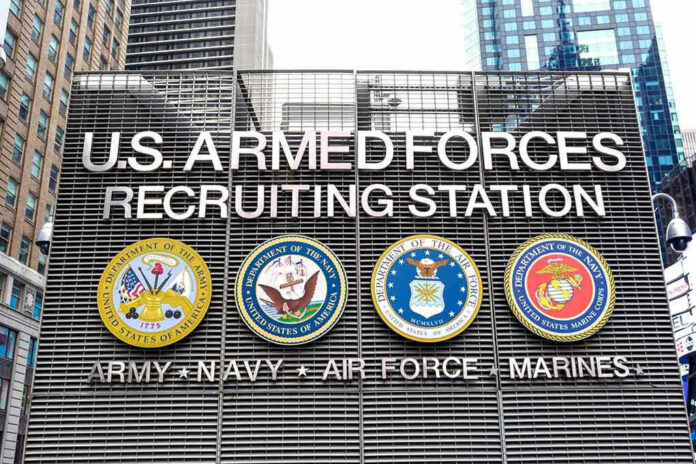
Defense Secretary Pete Hegseth’s push for ironclad military standards now equips recruiters with a frontline weapon to prescreen out 28 disqualifying medical conditions, ensuring only battle-ready patriots advance.[1]
Story Highlights
- MEPCOM implements prescreening for 28 conditions unlikely to receive waivers, halting processing early to save resources.[1]
- Policy builds on Hegseth’s July 2025 memo designating 13 non-waiverable and 13 waiver-requiring health issues.[1]
- Targets rising or common ailments like diabetes, peanut allergies, and sickle cell disease to focus on viable recruits.[1]
- Aims to boost efficiency amid recruiting challenges by reducing unnecessary medical exams.[1]
New Prescreening Targets 28 Disqualifying Conditions
U.S. Military Entrance Processing Command announced the policy on Monday, directing stations to flag applicants with any of 28 medical conditions deemed unlikely to be waived by service authorities.[1] Applicants testing positive skip the full physical exam required for enlistment. MEPCOM spokesperson Marshall Smith explained this stops processing for cases with little chance of approval, redirecting efforts to qualified candidates.[1] The move spares recruits false hope and cuts wasted evaluations.[1]
Conditions include sickle cell disease, disproportionately affecting African Americans, peanut allergies, and type I or II diabetes, which are rising among youth.[1] Other disqualifiers cover active cancer or recent remission, Crohn’s disease, severe eczema or psoriasis treated within a year, recent knee ligament ruptures, stress fractures, cochlear implants, pacemakers, recent antipsychotic use, multiple suicide attempts, and bipolar disorder.[1] Services agreed these pose high risks unlikely to overcome.[1]
Policy Aligns with Hegseth’s Readiness Directive
The prescreening complements a July 2025 memo from Defense Secretary Pete Hegseth, who identified 13 outright disqualifying conditions like cystic fibrosis, current epilepsy, and solid organ transplants, plus 13 needing secretary-level waivers such as schizophrenia or heart failure.[1] Hegseth’s April 2025 order launched a review of DoD Instruction 6130.03 medical standards to ensure recruits meet combat demands.[2] Waivers had surged to 17% of 2022 recruits from 12% in 2013, prompting tighter controls.[2]
Army Col. Megan McKinnon, USMEPCOM command surgeon, stated the policy triggers front-end checks requiring service sign-off, as all branches view these conditions as non-waivable.[1] This follows fiscal year 2025 prescreening of nearly half a million applicants using AI tools to review records faster.[1] Recruiters now prioritize those likely to serve, enhancing focus amid shortfalls.[1]
Strengthens Military Readiness and Efficiency
Experts affirm the list weighs battlefield risks and treatment costs, standard for waiver decisions.[1] DoD Instruction 6130.03 bars waivers for conditions demanding excessive duty time loss or limiting military adaptability. The policy halts processing for most flagged cases, except rare service-approved exceptions.[1] It addresses prior trends where relaxed standards during crises led to readiness gaps, now countered under Trump administration priorities.
Processing stations gain transparency, reducing basic training dropouts from undetected issues.[3] While a prior pilot eased waivers for 9,900 recruits with asthma or ADHD, this targets unwaiverable cases to build a fitter force.[3] Conservatives cheer Hegseth’s no-nonsense approach, rejecting woke dilutions that endangered troops with subpar health profiles. Recruiters consult chains of command for any pursuits, safeguarding standards.[1]
Sources:
[1] Military will now prescreen recruits for 28 medical conditions
[2] Medical Conditions That Can Keep You from Joining the Military
[3] DoD Eases Path for Recruits with Certain Medical Conditions – AUSA