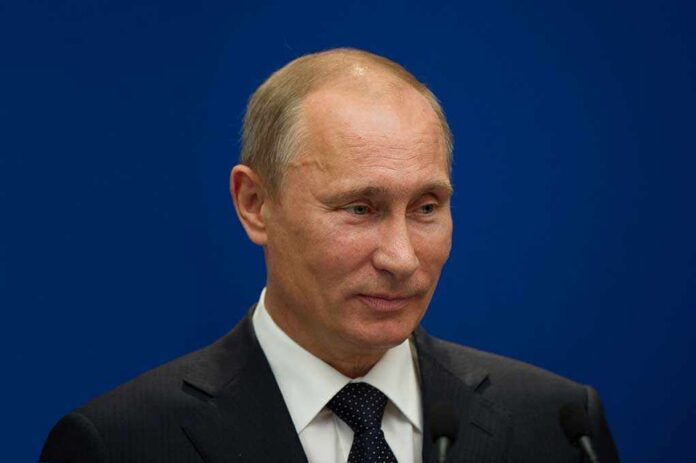
As Vladimir Putin says Volodymyr Zelensky can “come to Moscow any time,” both leaders are using peace-talk invitations less to end the war and more to shape the story of who is really blocking peace.
Story Snapshot
- Putin says he is ready to meet Zelensky in Moscow, with security guarantees and only to sign a pre-agreed deal.
- Zelensky has called for direct talks, but in a neutral country, and has rejected Moscow as an unsafe and unrealistic venue.
- Each side is turning public offers of meetings into tools to blame the other for blocking peace.
- This war-time “open invitation” game feeds public distrust that global elites talk about peace while letting the war grind on.
What Putin Is Really Offering With a Moscow Meeting
Russian President Vladimir Putin and his aides say they are open to direct talks with Ukrainian President Volodymyr Zelensky, but only on strict Russian terms. Putin has publicly stated that Zelensky can come to Moscow “any time” if he is ready for a meeting and that he has “never refused” such contact, so long as it leads to a “positive outcome.” A top Kremlin aide, Yuri Ushakov, repeated that any summit should take place in Moscow and promised full security and working conditions for Zelensky during the visit. At the same time, Putin has made clear he will only meet to finalize an already negotiated agreement and wants experts to prepare documents before any handshake at the top. That means the invitation is not for open-ended talks, but for Zelensky to travel into the capital of the invading country to sign something largely on Russia’s terms.
For many citizens in the United States and Europe who already distrust global institutions, this looks familiar. Leaders talk about “dialogue,” but the fine print shows that one side wants the other to come as a guest, not an equal partner. Putin’s demand that the talks be in Moscow, after years of war and mass casualties, sends a clear signal about power, not peace. Security guarantees from the same state that launched the invasion will ring hollow to people who have watched other broken promises, from failed ceasefires to shelled “safe corridors.” While Russian officials stress they are not refusing contact, they are defining “real talks” so narrowly that the chances of an actual breakthrough stay low.
How Zelensky Is Using Neutral Ground and Open Letters
Ukrainian President Volodymyr Zelensky has pushed for face-to-face talks but under very different conditions. In a rare open letter, Zelensky called for direct discussions with Putin to end the war and proposed a meeting in a neutral country, with a set date and a “full ceasefire” during negotiations. His message cast peace as urgent and argued that it should not wait until Washington or other capitals shift focus back from other crises. Zelensky’s team and Western media have highlighted that many neutral cities are ready to host and that Kyiv is not the side insisting on home-turf advantage. At the same time, Zelensky has flatly rejected Moscow as a venue. Speaking after one round of back-and-forth, he said inviting him to Moscow is what you do “if your aim is to prevent a meeting,” calling it proof that Russia does not truly want negotiations to succeed. For Zelensky, insisting on neutral ground is both a security issue and a way to show allies that Ukraine is not bending to what he sees as a conqueror’s script.
Zelensky has also admitted that his public outreach has another target: global opinion. In comments reported by independent outlets, he said his open letter to Putin was meant to show Ukraine’s allies “who is ready for peace and who is not,” once the Kremlin brushed it off. That fits a wider pattern where wartime diplomacy happens as much on television and social media as in closed rooms. By making his proposal public, Zelensky gave Western governments and their voters a clear record: Kyiv asked for direct talks under a ceasefire and neutral venue; Moscow answered with a demand to come to the capital of the aggressor. This kind of move speaks to people on both the left and right who feel they only hear filtered spin from official briefings. It lets them see, at least in part, the same documents world leaders are reading, even if both sides are still staging the conflict for cameras and donors.
War-Time Invitations as Political Theater, Not Path to Peace
Experts who study war and diplomacy say this kind of public “open invitation” is common in modern conflicts and rarely leads to real leader-to-leader talks. Research on recent wars finds that most such offers are about political signaling, not true negotiation pathways, and that in the vast majority of cases, no actual summit follows. Governments often shift from traditional quiet diplomacy to public diplomacy when battles are ongoing and trust is low. That means leaders use letters, press conferences, and summit soundbites to speak over each other’s heads to foreign publics, their own citizens, and rival elites. In the Russia–Ukraine war, both Putin and Zelensky are doing exactly that. Putin’s “he can come to Moscow” line plays well with Russians who want to see strength and with foreign voices who blame Kyiv or the West for blocking peace. Zelensky’s neutral-venue push and talk of revealing “who rejects peace” play well with Western audiences tired of endless aid packages and suspicious that someone, somewhere, prefers a forever war.
Zelensky says he would not travel to Moscow because "it's not safe due to Ukrainian drones."
He made the remark in response to President Trump asking whether he would be willing to travel to Moscow for a meeting with Putin. pic.twitter.com/PRf6ErUhlg
— China pulse 🇨🇳 (@Eng_china5) July 8, 2026
For Americans watching from home—whether they lean conservative or liberal—the whole exchange feeds a deeper frustration: the sense that global elites talk about peace while making sure nothing really changes. Conservatives see a Moscow-only offer as more proof that great powers treat borders and lives as bargaining chips, while Washington spends billions abroad and ignores problems at home. Liberals see Zelensky’s stalled push for neutral talks as another sign that military interests, energy politics, and defense contracts weigh more than civilian suffering. Both sides can also see how media framing shapes blame. Some outlets headline that “Zelensky rejects Moscow talks,” which can sound like Ukraine is the roadblock, without explaining the security risks or imbalance in meeting inside the aggressor’s capital. Others focus on Putin’s refusal to meet unless Ukraine first accepts Russian conditions, fueling anger at a system where those who start wars still control the terms of peace. For a public already wary of the “deep state,” these staged invitations confirm a hard truth: when wars become stage-managed, the people paying the price—on both sides of the front line, and in countries funding the conflict—are the last ones whose voices matter.
Sources:
youtube.com, ndtv.com, facebook.com, kyivpost.com, president.gov.ua, english.nv.ua, aa.com.tr, cambridge.org, pilpg-trainings.squarespace.com, rsisinternational.org
© patriotpostnews.com 2026. All rights reserved.